
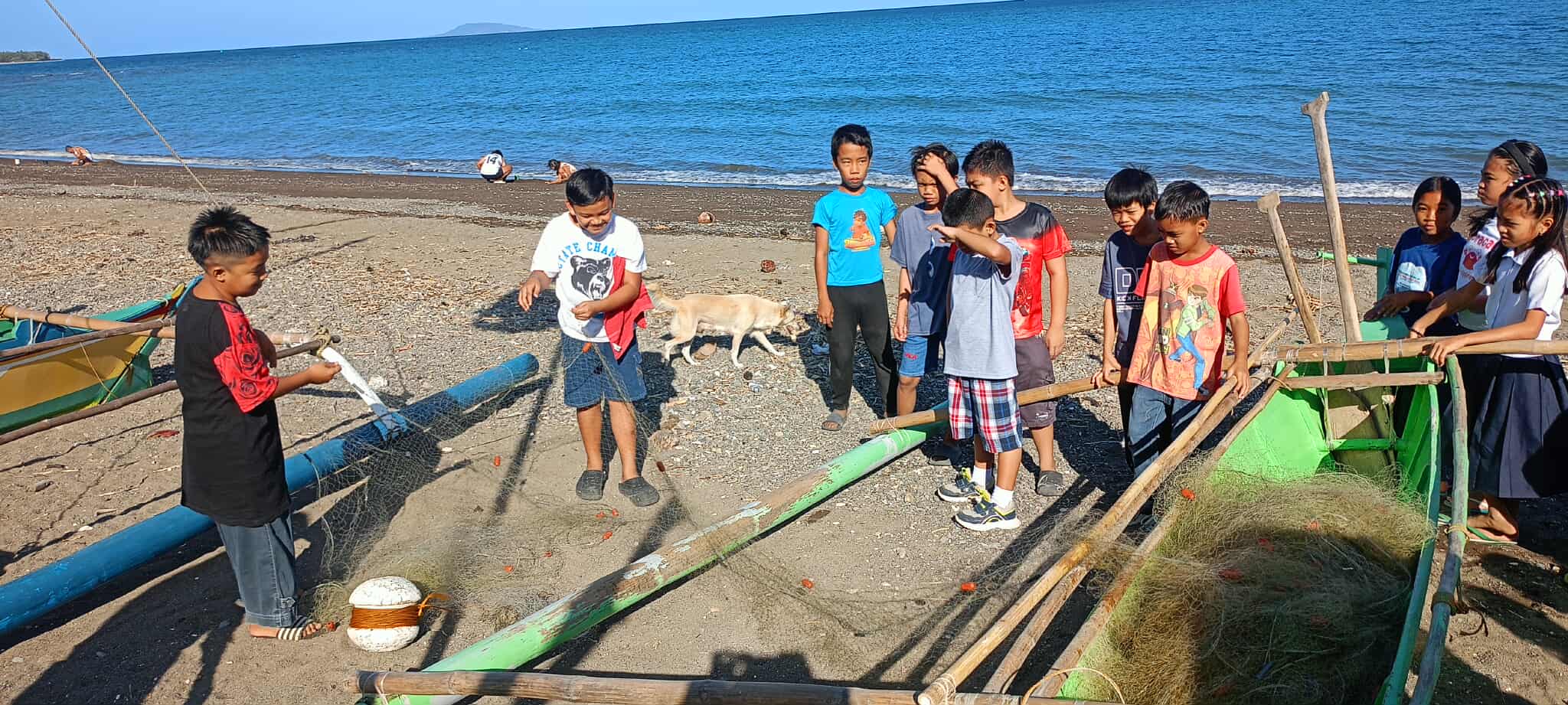
CULASI, Antique - The sea turtle appeared without warning.
As learners from Lipata-Lamputong Integrated School in Culasi, Antique explored the shoreline, excitement rippled through the group. For many of them, it was their first time seeing a sea turtle not on a television screen or in the pages of a textbook, but alive in the very waters surrounding their community.
The encounter lasted only a few moments, but for their teacher, Abegail B. Dimalaluan, its impact was unmistakable.
"One of the most memorable experiences for me and my students was participating in a hunters and farmers activity," she recalled. "During our field activity, we unexpectedly encountered live sea turtles, which made the experience even more meaningful. The learners immediately showed concern for the wildlife and became eager to learn about their protection."
Among those learners was Franz Geradila, whose excitement lingered long after the activity ended.
"I enjoyed the activity so much because we saw a sea turtle," he said. "I also learned sea turtles are born on land yet live in the sea."
That simple realization reflects something much deeper. Sometimes, environmental stewardship begins not with a lecture or a campaign, but with wonder.
Across coastal communities in Aklan, Antique, and Quezon, more children are discovering that the ocean is more than a backdrop to their daily lives. It is an ecosystem they belong to — and one they can help protect.
For many years, environmental lessons in schools were largely confined to classrooms. Learners learned about biodiversity through illustrations, diagrams, and memorized definitions. But when lessons moved outdoors, coastlines became living classrooms where every shell, mangrove, tide pool, and wave carried lessons books alone could never teach.
At Manocmanoc Elementary School in Malay, Aklan, teacher Kit C. Magdaluyo watched this transformation unfold firsthand.
"One of the most memorable activities for our learners was the beach exploration," he shared. "Many of them initially knew only a few marine species such as fish and hermit crabs, but through the activity, they discovered the rich diversity of life found along our coastlines."
Another activity brought students into nearby mangrove ecosystems, where they encountered a different side of coastal life.
"They also saw pollution issues firsthand," Magdaluyo said. "This experience helped them realize the importance of becoming sea guardians not only as individuals but also as members of a community."
Instead of simply hearing about marine pollution, learners saw discarded plastics tangled among mangrove roots. Instead of imagining biodiversity, they observed it with their own eyes. Environmental issues were no longer distant concepts but realities within their own neighborhoods.
In Quezon province, the same transformation emerged through different experiences.
Norma B. Gamboa, a teacher at Dinahican Elementary School in Infanta, observed that environmental lessons gradually became everyday habits.
"Through the program, our learners are taught to become responsible stewards of the environment, especially our oceans and marine life," she said.
Their activities ranged from waste segregation and tree planting to discussions on the effects of improper waste disposal. Over time, she noticed something changing beyond the classroom.
"I observed that the learners became more disciplined in disposing of waste properly."
These changes extended beyond environmental knowledge. Teachers began noticing qualities that are often harder to teach: responsibility, cooperation, initiative, and teamwork.
At Capalong Elementary School in Real, Quezon, teacher Kristel May C. Salomon saw learners eagerly participating in outdoor learning activities.
"Our learners showed great enthusiasm during the activities conducted outdoors," she said. "They actively participated in waste management and marine conservation efforts and demonstrated responsibility, cooperation, and teamwork throughout the activities."
Those lessons did not stop when classes ended.
For many families, children began bringing home conversations about protecting the sea, reducing waste, and caring for their surroundings. Environmental education quietly spread from classrooms into households and communities.
Reshel D. Escareses of Alitas Elementary School in Infanta believes that this broader support became one of the project's greatest strengths.
"One of my biggest realizations was the importance of the partnership among parents, the school, and the community," she reflected. "Their support played a vital role in the successful implementation of our environmental activities."
She also noticed meaningful changes among her learners.
"I observed positive changes among our learners, particularly in their discipline and ability to apply what they learned both at home and in school."
These stories emerged through the Junior Sea Guardian Project, an environmental education initiative of Haribon Foundation that partners with coastal schools to strengthen marine conservation learning through hands-on, community-based experiences. Rather than limiting environmental education to textbooks, the project encourages learners to experience coastal ecosystems directly, turning curiosity into understanding and understanding into action.
Supported by LifeBank Foundation, the initiative demonstrates how conservation begins long before adulthood. It begins with children who learn that the beach near their homes is not simply a place to visit, but an ecosystem worth protecting.
The changes may seem small — a child picking up litter without being told, reminding family members to segregate waste, or excitedly identifying a species encountered during a beach walk. Yet these everyday actions are the building blocks of environmental stewardship.
The sea turtle that surfaced before a group of students in Antique eventually disappeared beneath the waves. But the lesson it left behind remained.
For those young learners, protecting the ocean was no longer someone else's responsibility. It had become their own.
And perhaps that is how lasting environmental change begins — not through grand declarations, but through a single moment when a child sees the natural world with new eyes and chooses to care for it.
This story was contributed by Ritchel Cahilig of Haribon Foundation. We always look forward to curating the best stories out there and hearing from you. Feel free to send in your stories here.

Comments