
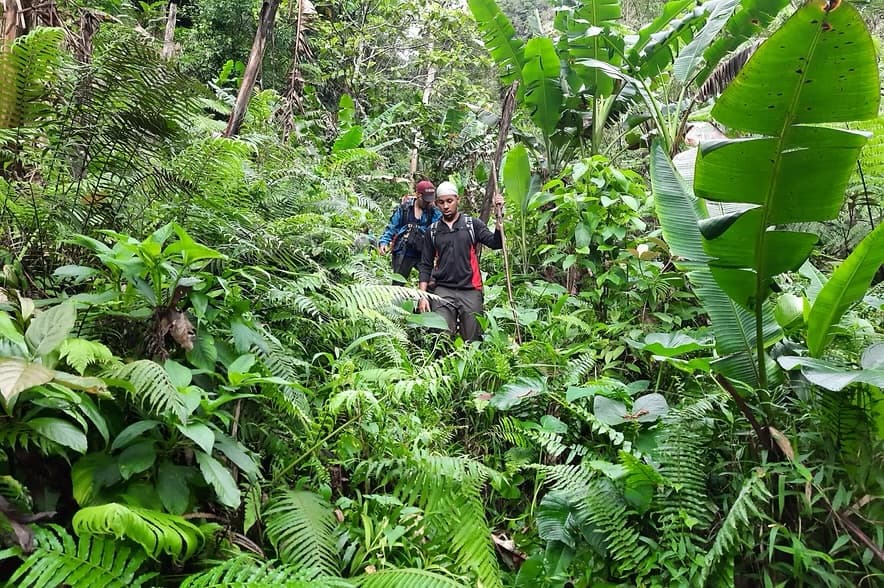
Before I joined Talarak Foundation, I stumbled upon a post about the organization while looking for work. I set out to send a volunteer application, hoping to gain experience in conservation. I did not fully understand that this decision would lead to waking up surrounded by trees and animals every morning.
The research house sits in the middle of the rainforest in Danapa, surrounded by a dense rainforest that stretches in every direction. Its beige exterior stands out against the sea of green, making it one of the few man-made structures visible in the landscape. As you reach the research house, you are greeted by the Danapa sign, accompanied by Bay, Bayawan City’s scarecrow mascot. As you walk toward the house, the signs of daily fieldwork are immediately noticeable. Rows of rain boots are stacked upside down to dry after rainy days in the field. Raincoats hang from railings, waiting for the next fieldwork or downpour, while slippers and hiking shoes line up by the entrance.
Inside, the research house is full and functional. A dining table sits at the center, where they share meals and discuss fieldwork plans. Beside it sits a small gas stove for preparing simple meals, while a wooden couch provides a place to rest after a long workday. The refrigerator, bathroom, shared sleeping quarters, and several desks complete the house. The tops of desks and shelves are often crowded with GPS units, binoculars, camera traps, radios, batteries, field guides, and bolos. Personal belongings mixed with field equipment, backpacks resting beside laptops, clothes hanging beside fieldwork pants, and hiking gear tucked in corners, ready for the next excursion. It may seem cluttered at first glance, but it reflects how our work follows us home.
Everyone at the research house contributes to keeping the nature reserve running. Justine, our Reserve Manager, oversees the nature reserve alongside the ground staff. James, our Volunteer Coordinator, trains volunteers and interns and guides them through their careers in conservation work. Deanne, our Head of Community and Social Impact from Bayawan, works with her team in the surrounding barangays, conducting IEC (Information, Education, and Communication) campaigns about the reserve and the animals we protect. Angeliegh is our Applied Conservation Researcher, who is currently studying pig deterrence to address human-wildlife conflict. I work as the Communications and Social Media Officer, documenting and promoting the work being done at Bayawan Nature Reserve and helping share its conservation efforts with a wider audience. Although our responsibilities differ, living and working around the reserve means we constantly learn from one another. Everyone I have met here has something to teach or share, whether from years of conservation experience or simply a different way of approaching a problem.
Life in the research house balances conservation work with the responsibilities needed to keep the household running. Our household chores are on rotation. Some evenings, we still track wildlife. Our workday might begin with slightly damp boots from yesterday’s research activities. Other days we might be indoors; rain can change our plans because of safety risks. The ever-changing tasks and environment have taught me to plan my days around both conservation work and household responsibilities. Despite the work and occasional frustrations, completing each task is rewarding, and I know these small responsibilities keep the team and the house moving.
“Life in the research house balances conservation work with the responsibilities needed to keep the household running.”
Before joining this simple research house, I hoped to gain practical experience in wildlife monitoring and animal care. Growing up, I understood conservation mostly through books, lectures, and documentaries. Many of the skills I wanted to develop, such as working with animals, conducting wildlife surveys, and using camera traps, were things I could only learn in a classroom. Getting to actually experience conservation by living and working in a nature reserve has been a dream come true. I learned through direct experience, watching field research techniques in action and applying them myself. More than that, living here has allowed me to discover more about myself, what I want to do, and what kind of conservationist I hope to become.
I didn't expect my experience to become so much broader. I came hoping to focus mainly on animal care and fieldwork. However, I have presented in schools, participated in conferences and radio talks, engaged with local communities, and communicated conservation work to a wider audience. These experiences have shown me that conservation is not only about protecting wildlife or collecting data, but also about building relationships with people, understanding ecosystems through patience and observation, and accepting that meaningful work often happens through small, consistent efforts.
I know I will not live inside this nature reserve forever. But I know this experience will stay with me wherever I go. For many people, a rainforest is a place to visit. For this chapter of my life, it has become home.

Comments