
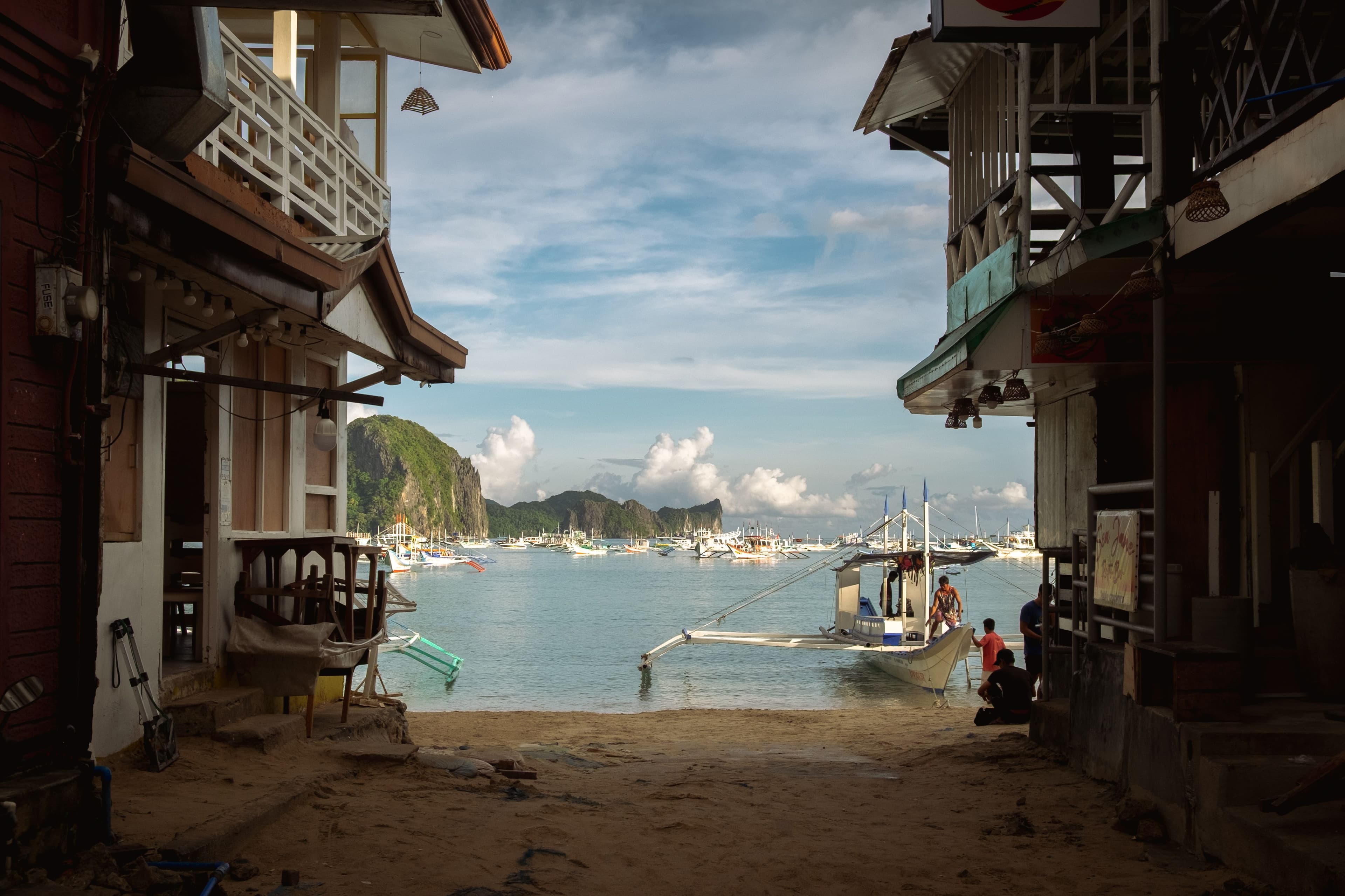
ROXAS, Palawan - A Reverse-Osmosis Water Station was recently completed on Green Island in Roxas, Palawan, meeting residents’ long-standing need for affordable drinking water.
The reverse-osmosis system filters particles and waste from seawater, turning it into safe drinking water. Spearheaded by the Provincial government, the project aims to establish a sustainable, community-based water resource in Green Island, located 14 kilometers from the mainland.
“It really helped us because we used to buy containers [of drinking water] from the mainland”, said Lably Medrina, a teacher and longtime resident of Green Island.
“I think we could have [a permanent source of] fresh water because we had a sample of the taps a few days ago. I can drink it even though it tastes a little like chlorine, but that could be because of what they put in the water [to treat it]. I heard that it was just saltwater they transferred into fresh water.”
Freshwater was sold in containers from the mainland. According to Diana Ross Cetenta, a Green Island resident and a journalist at Palawan Daily News, a container of mineral water would cost up to 60 PHP, while containers filled with water from the Water District in the Roxas mainland would be sold in stores at 40 PHP.
The Reverse-Osmosis Water Station has taps in each of the island's four zones, reducing costs to 25 PHP per container.
Medrina adds, “The water comes from tubes, so it is heavily filtered, but not all of us got to sample it because they limited it to one container per household.”
Richelle Belmonte, a resident of Green Island, praised the water system. “I’ve been hoping that [Green Island] will have our own water system. The station was built well.”
Green Island's new water supply, while still limited, benefits those who sustain life in the area, especially given its precarious position in Roxas' marine ecosystem.
A verdant heaven
Leslie Belmonte, a relative of Richelle and a high school student in Roxas, recalled how hard freshwater was to come by on the island.
“Before, my Lola Nida would have to get freshwater from Bagumbayan, Tumarbong; that’s where we would buy some [water]. Sometimes when there’s rain, and sometimes if there’s no water from the mainland… we would just collect rainwater, and that’s what we would use for cooking and taking baths. We used the rain, and we would drink it.”
Green Island has more than 300 residents as of March 2021, according to an article from the Philippine Information Agency.
The surrounding waters have even richer biodiversity. According to WWF-Philippines, Green Island Bay contains 12 of the 16 species of seagrass found in the Philippines. A monitoring report made by WWF in 2008 counts an overall total of 237 species from 34 families of fish; out of those, “19 were indicator species, 129 were major species, and 89 were target species.”
“The island is right next to a Marine Protected Area,” said Edgardo Padul, the Municipal Agriculturist of Roxas. “Roxas has 14 of these MPAs, including Brgy. Tumarbong where Green Island is located. It’s the number one source [in Roxas] of seagrass, with 200-400 hectares of active seagrass area. The island’s population is also increasing, with the percentage even higher than on the mainland. A few years ago, there were 15 children born in Green Island per year; now the number is up to 50.”
Leslie Belmonte remarked on this as well. “There weren’t so many of us back then, but now there’s a lot. Some started building houses by the beachfront. The seaweeds were on the other side [of the island],” she said. “But sometimes when the waves would reach the houses, they would flood. Just last year, my grandfather’s brother's house was flooded. They came into the new year with a flooded house.”
According to Padul, this population increase has had harmful effects on the surrounding waters of Green Island. “Unlike Kaliksi Island, there is still no waste or water treatment facility on the island, so the water has a high presence of Coliform, a bacterium that indicates waste material like fecal matter is present. That comes from piggery [on the island], human and animal waste, and kitchen waste as well.”
Affordable drinking water will be most helpful to residents whose seaweed crops failed earlier in the year due to a sudden temperature change in the seawater. With most of their seaweed washed out, income is scarce, and a cheaper source of drinking water will at least lighten the load.
When asked about the Reverse-Osmosis Water Station, Padul said that it was about time one was built on Green Island. Neighboring MPAs like Kaliksi Island, Johnson Island, and Cabugan Island already have their own sustainable sources of freshwater.
Kaliksi Island has a deep well and a water & waste treatment facility. Johnson Island and Cabugan Island already have the same operational Reverse-Osmosis Water System in Green Island, and the tubes that filter freshwater to Green Island run in the same area, away from the seagrass meadows. “We’ve had to ban trawl fishing in the waters,” Padul adds, “Because the nets might catch on to the tubes.”
Renewable sources of energy
In 2014, the United States Agency for International Development (USAID) built a hybrid renewable energy system on Green Island. This energy system included a solar grid and wind turbines to power the island community, an ice-flake machine maker to preserve local fishermen’s catches, and a desalination machine to provide drinking water.
“That was the proposed original plan, a desalination machine,” Padul said. “It would have directly converted the seawater into drinking water instead of the filtering system, but it couldn’t be materialized. The solar grid is still used as a main source of electricity on the island, but the wind turbines fell a while ago.”
In an interview with Palawan Daily News, Palawan Provincial Head of Infrastructure Projects Engr. Saylito Purisima said that the project “will be commissioned towards the end of February because we are still waiting for [desalination equipment] to come from Japan.”
Medrina, who teaches full-time in Green Island, hopes for a more stable source of drinking water. “There’s one faucet in each zone, so we only get water gradually, and I don’t know when it will be really, really stable. But for now this is good.”
This article was first written in 2021 by Helen Mae P. Padrones from Palawan as a final requirement of AYEJ.org and the US Embassy’s "Green Beat Islas: An Online Environmental Journalism Training."
Featured photo from JC Acosta of Palawan Moving Forward

Comments